Tuesday, July 02, 2024
Sculpt Your Legs Anywhere with This 7-Step Lower-Body Resistance Band Workout
No gym? No problem! With this 7-step resistance band workout, you can sculpt your legs and get your sweat on wherever you are. Incorporate it into your routine today!
Would you believe me if I told you that you could get an amazing leg workout at home, and you don’t even need to lift big weights? It’s true! How is this possible? Try this simple lower-body resistance band workout to save time and money and get a great leg workout in the process!
What are Resistance Bands and Why You Should Use Them?
Resistance bands are versatile, stretchy bands that provide resistance when stretched. They are made from durable rubber and come in various shapes, sizes, and levels of resistance. Unlike traditional weights, resistance bands offer variable resistance, increasing tension as they are stretched further. This makes them a perfect tool for both beginners and advanced fitness enthusiasts.
Using resistance bands can be extremely beneficial for those who want to get fit without investing in expensive gym equipment. They are lightweight, portable, and perfect for home workouts or when traveling. Additionally, resistance bands are gentle on the joints, making them ideal for physical therapy patients recovering from injuries.
Whether you're aiming to tone your legs, strengthen muscles, or improve flexibility, resistance bands can help you achieve these goals. They engage multiple muscle groups simultaneously, enhancing overall muscle coordination. Plus, they’re super affordable, so you won’t break the bank while getting into shape.
Benefits of Using Resistance Bands
Resistance bands offer numerous benefits that make them a valuable addition to any fitness routine. First and foremost, they are incredibly versatile. You can use them for a wide range of exercises that target different muscle groups, making your workouts more comprehensive and effective.
Another significant benefit is that resistance bands can help increase muscle strength and endurance. The varying levels of resistance allow you to progressively challenge your muscles, promoting growth and improving stamina over time. This progressive resistance is particularly beneficial for those looking to build muscle without lifting heavy weights.
In addition, resistance bands are excellent for improving flexibility and range of motion. Performing exercises with bands requires you to stretch your muscles through their full range, which can enhance flexibility and prevent injuries. For physical therapy patients, this can be especially helpful in regaining mobility and strength.
Different Types of Resistance Bands
Before jumping into the workout, it’s essential to understand the different types of resistance bands available. Choosing the right one for your workout can enhance your performance and results.
Loop Bands: These are circular bands that you can loop around your legs or arms. They are great for lower-body exercises such as squats and leg lifts.
Tube Bands: These bands have handles on each end, making them suitable for both upper and lower-body workouts. They often come with door anchors, allowing for a variety of anchored exercises.
Therapy Bands: These flat bands are commonly used in physical therapy. They are great for gentle stretching exercises and rehabilitation.
Each type of band offers its unique benefits, so you might want to have a variety on hand to maximize your workouts. Now that you’re familiar with resistance bands, let's move on to the actual workout.
7-Step Lower-Body Resistance Band Workout
Ready to get those legs moving? Here’s a seven-step workout that targets all the major muscles in your lower body. Each exercise is designed to build strength, enhance flexibility, and improve overall fitness.
1. Clam Shells
Clamshells are an excellent exercise for targeting the glutes and hip muscles. To perform this exercise:
Start Position:
Lie on your side with your knees bent at a 90-degree angle.
Place the resistance band just above your knees.
Movement:
Keeping your feet together, lift your top knee as high as you can without moving your pelvis.
Lower your knee back to the starting position.
Repetitions:
Perform 15-20 reps on each side.
Clamshells help strengthen the gluteus medius, essential for stabilizing the pelvis and preventing injuries.
2. Banded Romanian Deadlift
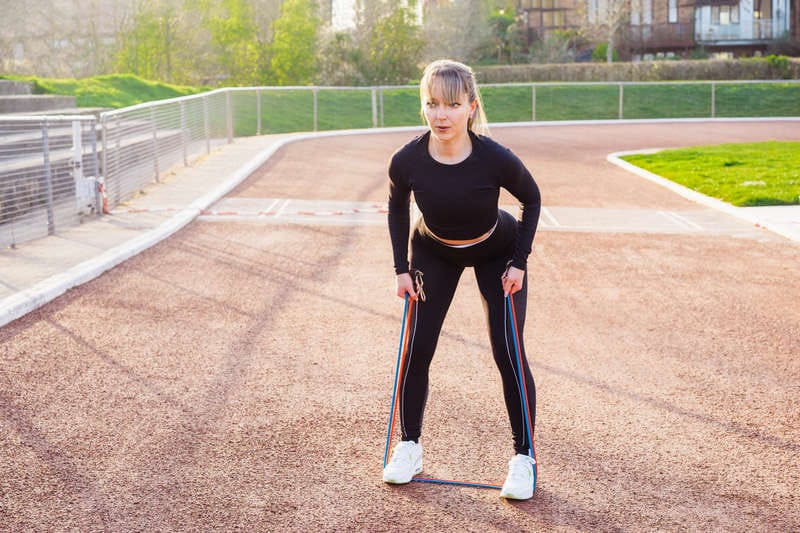
The Banded Romanian Deadlift is fantastic for targeting the hamstrings and glutes. Here’s how to do it:
Start Position:
Stand on the resistance band with your feet shoulder-width apart.
Hold the ends of the band in each hand.
Movement:
Hinge at your hips, keeping your back straight and knees slightly bent.
Lower your torso until you feel a stretch in your hamstrings.
Return to the starting position by driving your hips forward.
Repetitions:
Perform 12-15 reps.
This exercise helps build posterior chain strength, crucial for overall lower-body power.
3. Banded Calf Raises
Calf raises with a resistance band are great for strengthening the calf muscles. Follow these steps:
Start Position:
Stand on the resistance band with your feet hip-width apart and hold the ends in each hand.
Movement:
Raise your heels off the ground as high as possible.
Slowly lower your heels back to the ground.
Repetitions:
Perform 20-25 reps.
Banded calf raises help develop strong, sculpted calves, enhancing overall leg appearance.

4. Forward Resistance Band Walk
This exercise targets the quads, glutes, and hip flexors. Here's how to do it:
Start Position:
Place the resistance band around your ankles.
Movement:
Take a step forward with one foot, followed by the other foot.
Keep your steps controlled and maintain tension in the band.
Repetitions:
Take 15-20 steps forward and then walk back to the starting position.
Forward band walks improve hip stability and leg strength, making them an excellent functional exercise.
5. Lateral Band Walk
Lateral band walks are perfect for targeting the hip abductors and glutes. Follow these steps:
Start Position:
Place the resistance band around your ankles.
Movement:
Step to the side with one foot, followed by the other foot.
Keep your steps small and controlled.
Repetitions:
Take 15-20 steps to each side.
Lateral band walks enhance hip stability and strength, crucial for preventing injuries.
6. Glute Kicks
Glute kicks are excellent for isolating and strengthening the glutes. Here’s how to perform them:
Start Position:
Get on all fours and place the resistance band around your thighs.
Movement:
Extend one leg backward, keeping the knee bent.
Squeeze your glute at the top of the movement.
Repetitions:
Perform 15-20 reps on each side.
Strong glutes are essential for overall lower-body strength and stability.

See other posts like this one:
Saturday, March 01, 2025
Transforming from the Inside Out: The Inspiring Journey of Danielle Edwards

Saturday, March 01, 2025
The Power of Optimism: How a Positive Mindset Boosts Health and Happiness





Friday, February 28, 2025
Slow Motion Strength Training: The Power of 10 for Maximum Results